
You wash the truck, it looks perfect wet, and twenty minutes later the whole hood is covered in white rings. Or worse, you parked next to a sprinkler head all summer and now the passenger side looks like somebody dusted it with chalk. Figuring out how to remove water spots from car paint and glass comes down to one thing most people never get told: there are three different kinds of water spots, and each one needs a different fix. Use the wrong approach and you'll scrub for an hour and change nothing.
This guide walks the ladder from easiest to hardest. Start at the top, only move down if you have to, and you'll get the finish back without ever touching a polisher.
What Water Spots Actually Are
Water is almost never just water. Tap water, well water, and sprinkler water all carry dissolved minerals, mostly calcium and magnesium. When a droplet sits on your paint and evaporates, the water leaves and the minerals stay behind. That white ring is the mineral outline of a droplet that dried in place.
The longer it sits, and the hotter the panel gets, the harder that deposit bonds. That's why the same sprinkler that leaves an easy smudge in April leaves a crust in August.
The Three Stages, and Why They Matter
- Stage 1, fresh deposits. Days old, sitting on top of the surface. These come off with a rewash. If you catch them here you're done in fifteen minutes.
- Stage 2, bonded mineral deposits. Weeks or months old. Soap won't touch them because soap is not designed to dissolve minerals. This is the stage where an acid-based cleaner earns its keep, and it's where most trucks are by the time somebody goes looking for answers.
- Stage 3, etching. The mineral sat so long that it ate a shallow crater into the clear coat. No chemical fixes this, because there's nothing left to dissolve. The defect is in the paint itself and it takes polishing or wet sanding.
Here's the quick field test. Wet the panel down. If the spots disappear while wet and come back as it dries, you're at stage 1 or 2 and chemistry will fix it. If you can still see them clearly while the panel is soaking wet, you're at stage 3 and you're looking at paint correction.
Step 1: Rewash Before You Do Anything Else
Do not skip this. A proper wash removes every fresh deposit plus the road film sitting on top of the older ones, and it tells you what you're actually dealing with. Half the time people reach for something aggressive on spots a bucket of soap would have taken off.
Wash in the shade, on a cool panel, top to bottom. Liberty Soap lays down thick foam that lifts grit off the surface before your mitt drags it around, which matters here because you're about to look at the paint very closely and you don't want to add swirls to the list.
Then dry it immediately. Do not let it air dry, or you'll be putting fresh water spots on while you're removing the old ones. Clean microfiber towels, or a blower if you have one.
Whatever is still there after that wash is bonded, and it's time for step 2.
Step 2: How to Remove Water Spots From Car Paint With an Acid Cleaner
Mineral deposits are alkaline. Soap is not going to dissolve them no matter how long you scrub or how much elbow grease you put behind it. What dissolves them is an acid-based cleaner made for vehicle surfaces.
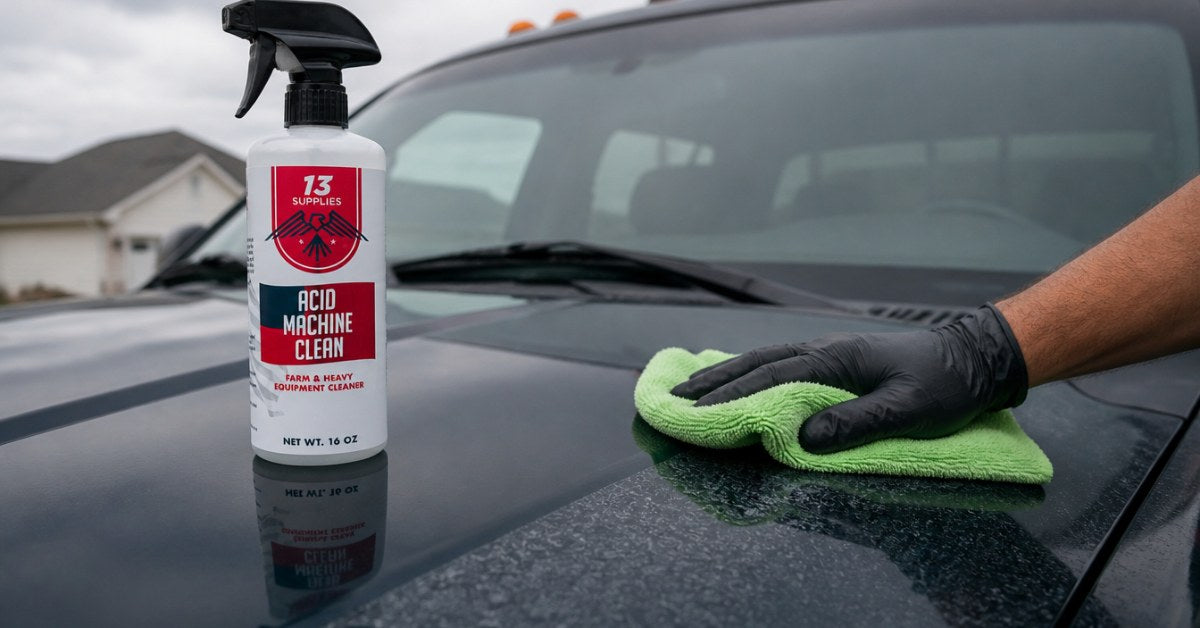
Acid Machine Clean is what we use for this. It's built for vehicles, boats, RVs and equipment, which is exactly the mix of glass, chrome, aluminum and painted surface you're dealing with on a truck that's been sitting under a sprinkler.
Read the label and follow it. Dilution, dwell time, and approved surfaces are all on the bottle, and an acid cleaner is one product where guessing is a bad idea. What follows are the working conditions that apply on top of those directions.
Ground Rules for Working With an Acid Cleaner
- Cool surface, full shade. Never a hot panel and never in direct sun. Heat accelerates the reaction and dries the product before you can rinse it.
- Test a small spot first. Somewhere out of sight, like the lower rear quarter behind the wheel. Check the result before you commit to the whole truck.
- Never let it dry on the surface. This is the mistake that causes damage. If a panel is starting to dry, rinse it and start that panel again.
- Work one panel at a time. Not the whole side. One panel, rinse, next panel.
- Rinse thoroughly. More than you think. Then rinse the panel below it too, because residue runs downhill.
- Gloves and eye protection. Every time, no exceptions.
Glass and chrome usually clear up fast. Painted surfaces take a gentler hand and sometimes a second pass. If a spot lightens but doesn't fully go, a second application beats scrubbing harder.


A Note on the Vinegar Trick
You'll see a lot of advice online about a 50/50 vinegar and water mix. It does work on light glass spotting, because vinegar is a weak acid and glass is tough. On paint it's a different story. It's inconsistent, it's not formulated for automotive clear coat, and it has no corrosion inhibitors in it. Use it on your windows if that's what you have on hand. Don't use it as your plan for the whole truck.
Step 3: When It's Etched, Chemistry Is Done
If the spots are still visible on a soaking wet panel after you've done the wash and the acid step, the mineral is gone and what you're seeing is a dish in the clear coat. There is no cleaner that fills a crater.
From here you have three options, in order of cost:
- Light polish by hand. A fine polish and a foam applicator will knock down shallow etching. Slow, but cheap and hard to mess up.
- Machine polish. Faster and far more effective across a whole panel. If you've never run a polisher, practice somewhere nobody looks.
- Let a pro handle it. Deep etching across multiple panels is a real paint correction job.
How to Remove Water Spots From Car Glass, Chrome, and Wheels
Water spots don't stop at the paint. Glass is usually the worst of it, because you're looking straight through the deposits every time you drive. Chrome bumpers, exhaust tips and polished aluminum wheels collect them too, and on bare metal they tend to bond harder than they do on clear coat.
Same order applies. Wash first, acid cleaner on what's left, then rinse well. Glass usually clears up on the first pass.
If your windshield still looks hazy after the outside is spotless, that haze is dashboard off-gassing on the inside, and the interior glass guide covers that one.
Running the same job on aluminum? Oxidation and water spots on bare aluminum behave differently than they do on painted steel, and the aluminum guide has the details.
How to Prevent Water Spots on Your Truck
Removing them is work. Not getting them is easy, and it's mostly about where you park and how you dry.
- Move away from sprinklers. Irrigation water is the number one cause we see. It's frequent, it's mineral heavy, and it hits the same panels every single day. Park somewhere else and half the problem disappears.
- Never let a wash air dry. Dry every panel with microfiber or a blower before you move to the next one. On a hot day, wash and dry one panel at a time.
- Wash in the shade on a cool surface. A hot panel flashes water off before you can get to it.
- Keep a coat of protection on the paint. Wax or sealant makes water bead and roll off instead of sitting in a puddle, which means fewer deposits and easier removal when they do happen.
- Deal with them early. A fresh spot is a rewash. A three-month-old spot is an afternoon. Same spot, very different job.
If you're stocking up on the wash and the cleaner at the same time, the bundles work out cheaper than buying the bottles one at a time.
One more thing: road film makes spotting look worse than it is, because minerals bond to grime more readily than to clean clear coat. Keeping a bottle of Machine Clean around for the lower panels and rockers cuts that buildup down.
Water Spot FAQ
Why do water spots come back so fast after I remove them?
Almost always the source is still there. Sprinklers, a hard water hose, or air drying after every wash. Removing the spots is the easy part. If the truck keeps getting hit with mineral water and keeps air drying, you'll be doing it again in a month. Fix the source first.
Will an acid cleaner damage my clear coat?
Used according to the label directions, on a cool surface, in the shade, and rinsed thoroughly, an acid cleaner made for vehicles is safe on factory clear coat. Damage happens when it dries on the panel, when it goes on a hot surface in direct sun, or when it sits far longer than the directions call for. Test a hidden spot first and follow the bottle.
Are water spots on glass different from water spots on paint?
Same minerals, tougher surface. Glass takes a chemical clean better than paint does and clears up faster. Glass also etches, though, and etched glass is harder to fix than etched paint because you can't polish it as easily. Get the spots off your windshield sooner rather than later.
Get After It
So that's how to remove water spots from car paint, glass and chrome without guessing. Wash first and see what's really left. Hit the bonded deposits with an acid cleaner on a cool panel in the shade, following the label. Save polishing for the spots that survive a soaking wet panel test. Then move the truck away from that sprinkler and dry it properly, and you won't be back here next month.
Everything we make is made in America. We're a family business that started because the cleaners on the shelf couldn't handle what our own equipment threw at them. That story is on our story page. A portion of every order goes toward supporting our troops through the Wounded Warrior Project.
Pick up a bottle of Acid Machine Clean, wait for a cool morning in the shade, and get your finish back.

Leave a comment
This site is protected by hCaptcha and the hCaptcha Privacy Policy and Terms of Service apply.